
Acitzone-25 Capsule
Acitretin Capsules IP 25 mg
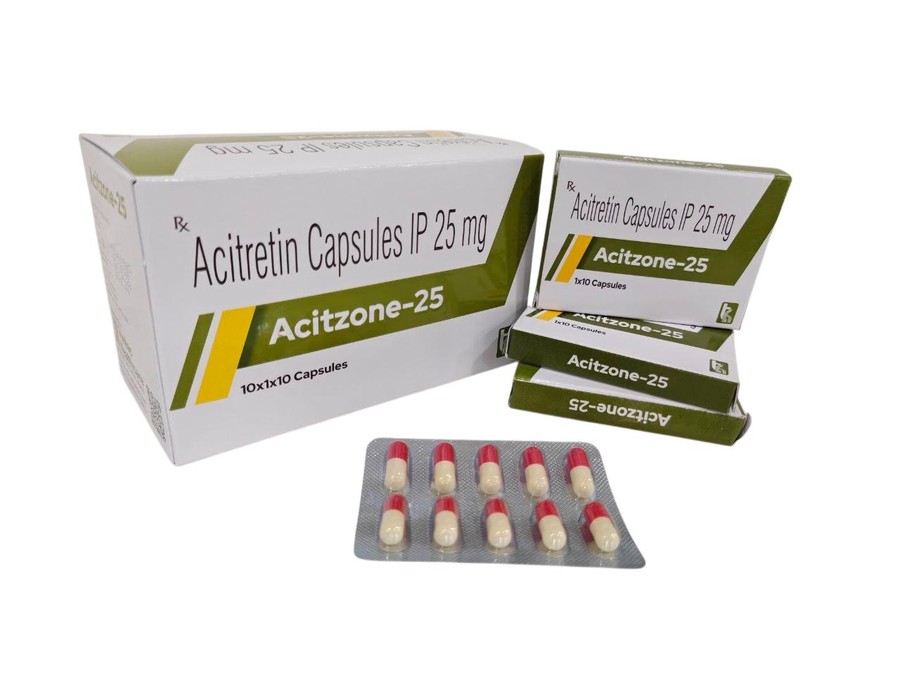
| Composition | Acitretin IP 25 mg |
|---|---|
| Dosage Form | Capsule |
| Pack Type | Blister |
| Pack Size | 10 x 1 x 10 Capsules |
| MRP | ₹ 6990 |
| Therapy | Dermatology — Second-Generation Oral Systemic Retinoid |
| Storage | Store below 25 °C in a dry place, protected from light and moisture. Keep the capsules in the original blister until use. Keep out of reach of children. Dispense strictly on a dermatologist's prescription. |
📱 WhatsApp Enquiry📞 Call: +919041677932
About Acitzone-25 Capsule
Acitzone-25 Capsule contains Acitretin IP 25 mg — a second-generation oral systemic retinoid indicated for the treatment of severe, recalcitrant psoriasis and disorders of keratinisation. Manufactured by Trumac Healthcare under WHO-GMP certified conditions and supplied in light-protective blister packing.
Acitretin is the pharmacologically active metabolite of etretinate. It binds nuclear retinoic acid receptors and normalises the abnormal epidermal cell proliferation, differentiation and keratinisation that underlies psoriasis and the ichthyoses, while also exerting a direct anti-inflammatory effect. Clinically this translates into a marked reduction in the scaling, thickness and erythema of plaques, and it is particularly valuable in pustular and erythrodermic forms of psoriasis where conventional therapy has failed.
Acitretin is a specialist-initiated therapy. It is severely teratogenic and is absolutely contraindicated in pregnancy — pregnancy must be prevented during treatment and for 3 years after the last dose. Alcohol must be avoided entirely, and regular liver function and lipid monitoring is mandatory. Acitzone-25 is available for pan-India monopoly PCD franchise and third-party manufacturing under your own brand.
Indications
- Severe, recalcitrant plaque psoriasis unresponsive to other systemic therapy
- Generalised pustular psoriasis (von Zumbusch type) and localised palmoplantar pustulosis
- Erythrodermic psoriasis
- Palmoplantar psoriasis and palmoplantar keratoderma
- Congenital ichthyoses — lamellar ichthyosis, congenital ichthyosiform erythroderma, X-linked ichthyosis
- Darier's disease (keratosis follicularis)
- Pityriasis rubra pilaris
- Severe lichen planus, including hypertrophic and oral forms
- Other severe disorders of keratinisation resistant to conventional treatment
Mechanism of Action
Acitretin is an aromatic synthetic analogue of retinoic acid (vitamin A) and is the principal pharmacologically active metabolite of etretinate. Unlike the immunosuppressants used in psoriasis, its action is fundamentally one of gene regulation. Acitretin binds to and activates the nuclear retinoic acid receptors (RAR-alpha, RAR-beta and RAR-gamma) and, indirectly, the retinoid X receptors (RXR). These ligand-activated receptors form heterodimers that bind retinoic-acid-response elements in the promoter regions of target genes, thereby modulating transcription of the genes that govern epidermal cell proliferation, terminal differentiation and cornification. The clinical result is normalisation of the accelerated keratinocyte turnover and defective differentiation characteristic of psoriasis and the ichthyoses — thinning of the hyperkeratotic stratum corneum, reduction in scaling and plaque thickness, and restoration of a more orderly epidermal architecture. Acitretin additionally exerts anti-inflammatory activity by suppressing neutrophil chemotaxis and migration into the epidermis, which explains its particular efficacy in the pustular variants of psoriasis, and it downregulates pro-inflammatory cytokine expression and reduces the abnormal expression of keratins K6 and K16. Importantly, acitretin is not immunosuppressive, which makes it a useful option in patients in whom immunosuppression is undesirable, and allows it to be combined with phototherapy (Re-PUVA) for a synergistic effect at lower doses of both. A critical pharmacokinetic point: in the presence of alcohol, acitretin undergoes re-esterification to etretinate, which has an elimination half-life of approximately 120 days and accumulates in adipose tissue. This is the reason alcohol is strictly prohibited and the reason the post-treatment pregnancy-prevention period extends to 3 years.
Dosage & Administration
STRICTLY SPECIALIST-INITIATED — to be prescribed only by, or under the supervision of, a dermatologist experienced in systemic retinoid therapy.
ADULTS — INITIAL: 25 mg to 30 mg once daily, taken as a single dose WITH THE MAIN MEAL or with milk. Absorption is markedly increased by food and is erratic on an empty stomach, so consistent administration with a meal is essential.
MAINTENANCE: after 4 weeks the dose is adjusted according to clinical response and tolerability, usually within the range 25–50 mg once daily. The maximum recommended dose is 75 mg daily. Treatment of psoriasis typically continues for 6–8 weeks to reach optimal response; therapy is then usually stopped once lesions have resolved sufficiently.
DISORDERS OF KERATINISATION: lower maintenance doses are often adequate and long-term intermittent therapy may be required.
Re-PUVA: when combined with PUVA phototherapy, lower doses of both acitretin and UV exposure are used — this reduces cumulative retinoid and UV toxicity.
MANDATORY MONITORING: liver function tests and fasting lipid profile (triglycerides and cholesterol) at baseline, then every 1–2 weeks until stable, then at least every 3 months. In women of childbearing potential a negative pregnancy test is required before starting, monthly during treatment, and periodically for 3 years after stopping. Long-term therapy warrants periodic radiological assessment for skeletal hyperostosis and, in children, monitoring of growth and bone development.
PATIENT COUNSELLING — NON-NEGOTIABLE: no alcohol in any form during treatment and for 2 months after the last dose. No blood donation during treatment and for 3 years after. Strict photoprotection. Do not take vitamin A supplements or any other retinoid concurrently.
Side Effects
Adverse effects are dose-related and affect the great majority of patients to some degree — most are mucocutaneous and reversible on dose reduction or withdrawal.
VERY COMMON MUCOCUTANEOUS: cheilitis (dry, cracked lips — occurs in nearly all patients and is a reliable marker of adequate dosing), xerosis and generalised skin dryness, dry nasal mucosa and epistaxis, dry mouth and thirst, xerophthalmia and conjunctivitis with contact-lens intolerance, skin peeling especially of the palms and soles, skin fragility and stickiness, pruritus, paronychia and nail fragility, and diffuse reversible hair thinning or alopecia.
METABOLIC AND HEPATIC: hypertriglyceridaemia and hypercholesterolaemia with reduced HDL — the most frequent laboratory abnormality and the reason lipid monitoring is mandatory; markedly raised triglycerides carry a risk of acute pancreatitis. Reversible elevation of transaminases; hepatitis is uncommon but has been reported.
MUSCULOSKELETAL: arthralgia and myalgia; with prolonged high-dose therapy, skeletal changes including diffuse idiopathic skeletal hyperostosis (DISH), extra-spinal calcification and premature epiphyseal closure in children.
OPHTHALMIC AND NEUROLOGICAL: impaired night vision, which may be sudden in onset — patients must be warned before driving at night; photophobia; corneal opacities. Benign intracranial hypertension (pseudotumour cerebri) presenting as headache, nausea, vomiting and visual disturbance — the risk is greatly increased by concomitant tetracyclines, and any such presentation requires immediate discontinuation and neurological assessment.
OTHER: photosensitivity, headache, fatigue, and rarely mood changes.
Contraindications & Precautions
ABSOLUTE CONTRAINDICATION — PREGNANCY AND TERATOGENICITY: Acitretin is a potent human teratogen and is ABSOLUTELY CONTRAINDICATED IN PREGNANCY. Exposure at any dose, even for a short period, carries a high risk of severe congenital malformations affecting the craniofacial, cardiovascular, skeletal and central nervous systems. It must not be given to any woman who is pregnant or who may become pregnant during treatment or within 3 YEARS OF STOPPING. Women of childbearing potential may be treated only if every one of the following is satisfied: severe disorder of keratinisation resistant to standard therapy; full understanding of and written consent to the risk; two reliable forms of contraception used simultaneously, begun at least 1 month before starting, continued throughout treatment, and maintained for 3 YEARS after the last dose; a negative pregnancy test within 1 week of starting, repeated monthly during therapy and periodically for 3 years afterwards. Progestogen-only 'mini-pill' contraception is NOT acceptable, as it may be rendered ineffective. Pregnancy occurring during or within 3 years of treatment requires urgent specialist obstetric assessment.
ALCOHOL — ABSOLUTELY PROHIBITED: alcohol converts acitretin to etretinate, which has a half-life of roughly 120 days and accumulates in fat. Alcohol in any form, including foods and medicines containing it, must be avoided during treatment and for 2 months after the last dose. This interaction is the reason the pregnancy-prevention period is 3 years rather than 2 months.
BLOOD DONATION: prohibited during treatment and for 3 years afterwards, as donated blood could reach a pregnant recipient.
OTHER CONTRAINDICATIONS: breastfeeding. Severe hepatic impairment. Severe renal impairment. Chronic, markedly elevated blood lipids. Hypersensitivity to acitretin, other retinoids or to parabens (present in the capsule formulation). Concomitant tetracyclines — combined use risks benign intracranial hypertension. Concomitant methotrexate — risk of severe hepatitis. Concomitant vitamin A supplements or other retinoids — risk of cumulative hypervitaminosis A.
FURTHER PRECAUTIONS: diabetes mellitus — glucose tolerance may be altered, so monitor more closely. History of pancreatitis or existing hypertriglyceridaemia. Contact-lens wearers frequently become intolerant owing to dry eyes. Patients must be warned about impaired night vision before driving after dark. Concomitant phenytoin — acitretin may displace it from protein binding. Long-term therapy in children requires close monitoring of growth and skeletal development.
Storage
Store below 25 °C in a dry place, protected from light and moisture. Keep the capsules in the original blister until use. Keep out of reach of children. Dispense strictly on a dermatologist's prescription.
Acitzone-25 Capsule is available for monopoly-based PCD pharma franchise across India and for third-party manufacturing under your brand. WHO-GMP certified, with full visual-aid and promotional support. Become a Trumac franchise partner →
Frequently Asked Questions
What is Acitzone-25 Capsule used for?
Acitzone-25 contains Acitretin IP 25 mg, a second-generation oral systemic retinoid. It is used for severe, recalcitrant psoriasis — including generalised pustular psoriasis, erythrodermic psoriasis, palmoplantar psoriasis and severe plaque psoriasis that has not responded to other treatments. It is also used in disorders of keratinisation such as congenital ichthyosis, Darier's disease, pityriasis rubra pilaris and severe lichen planus.
How does Acitretin work?
Acitretin is a vitamin-A derivative that works at the level of gene expression. It binds nuclear retinoic acid receptors, which then regulate the genes controlling how skin cells grow, mature and form the outer horny layer. In psoriasis and the ichthyoses these processes are abnormally accelerated and disordered; acitretin normalises them, thinning the scale and reducing plaque thickness and redness. It also suppresses neutrophil migration into the skin, which is why it works particularly well in pustular psoriasis. Notably, it is not an immunosuppressant.
Why must pregnancy be avoided for 3 years after stopping?
Acitretin is a severe teratogen. On its own it clears reasonably quickly, but in the presence of alcohol it converts back to etretinate — a related compound with a half-life of around 120 days that stores in body fat and is released slowly for a very long time. Because complete avoidance of alcohol cannot be guaranteed in practice, the pregnancy-prevention requirement is set conservatively at 3 years after the last dose. Two reliable forms of contraception must be used simultaneously throughout, and the progestogen-only mini-pill is not acceptable.
Why is alcohol completely prohibited?
Alcohol causes acitretin to be re-esterified into etretinate, which has a vastly longer half-life and accumulates in fatty tissue. This both prolongs the teratogenic risk enormously and increases cumulative toxicity. Alcohol must be avoided in every form — including in foods, tonics and medicines containing it — during treatment and for 2 months after the final dose.
How should Acitzone-25 be taken?
The usual adult starting dose is 25–30 mg once daily, taken as a single dose with the main meal or with milk. This matters: acitretin is absorbed far better with food, and absorption is erratic on an empty stomach. After about 4 weeks the dermatologist adjusts the dose based on response, usually within the 25–50 mg daily range. Courses for psoriasis typically run 6–8 weeks to reach the best response.
What monitoring is needed during treatment?
Liver function tests and a fasting lipid profile are required at baseline, then every 1–2 weeks until stable, and at least every 3 months thereafter. Women of childbearing potential need a negative pregnancy test before starting, monthly during treatment, and periodically for 3 years afterwards. Long-term therapy also warrants periodic X-ray assessment for skeletal changes, and in children, monitoring of growth and bone development.
What are the most common side effects?
Dry, cracked lips (cheilitis) occurs in nearly every patient and is actually used as a rough marker of adequate dosing. Other common effects are generally dry skin, dry nose with occasional nosebleeds, dry eyes with contact-lens intolerance, peeling of the palms and soles, temporary hair thinning, and brittle nails. Raised blood triglycerides and cholesterol are the commonest laboratory abnormality. Most effects are dose-related and reverse when the dose is reduced or the drug is stopped.
Can Acitretin affect night vision or driving?
Yes. Acitretin can impair night vision, and the onset can be sudden. Patients must be warned about this before starting and should be cautious about driving after dark. Any new visual disturbance should be reported promptly. Severe headache with nausea, vomiting and visual changes may indicate benign intracranial hypertension and requires immediate medical attention — this risk is much higher if tetracycline antibiotics are taken at the same time.
Who must NOT take Acitzone-25?
It is absolutely contraindicated in pregnancy and breastfeeding, and in any woman who may become pregnant during treatment or within 3 years of stopping unless the full pregnancy-prevention programme is followed. Also contraindicated: severe liver or kidney impairment, chronically high blood lipids, hypersensitivity to retinoids or parabens, and concurrent use of tetracyclines, methotrexate, vitamin A supplements or other retinoids. Patients must not donate blood during treatment or for 3 years afterwards.
Can Acitretin be combined with phototherapy?
Yes — the combination is known as Re-PUVA and is a well-established approach. Because acitretin and phototherapy act synergistically, lower doses of both can be used, which reduces cumulative retinoid toxicity and total UV exposure. This must be managed by a dermatologist, and photoprotection remains important since acitretin itself causes photosensitivity.
Is Acitzone-25 Capsule available for PCD franchise?
Yes. Acitzone-25 Capsule is available from Trumac Healthcare for pan-India monopoly PCD (Propaganda Cum Distribution) pharma franchise and for third-party manufacturing under your own brand. We supply WHO-GMP manufactured stock with full QC documentation, batch COA and competitive net rates. Contact us on WhatsApp at +91 90416 77932 for pricing, packs and monopoly territory availability.
What is the packing and MRP?
Acitzone-25 Capsule is supplied in blister packing — 10 x 1 x 10 Capsules per box (10 blisters of 10 capsules each = 100 capsules per box). MRP is ₹ 6990 per box. Blister packing protects the capsules from moisture and light, which matters because acitretin is light-sensitive.
How quickly can Trumac Healthcare dispatch a PCD order?
Routine PCD orders are dispatched within 48 hours of payment realisation, subject to stock availability and your distance from our depot. For monopoly partners we maintain buffer stock against forecasted monthly off-take.