
PHYTORUT-200 Capsule
Itraconazole 200 mg Capsules – Derma & Gynae PCD Pharma Franchise, Wholesale Supply & Third Party Manufacturing
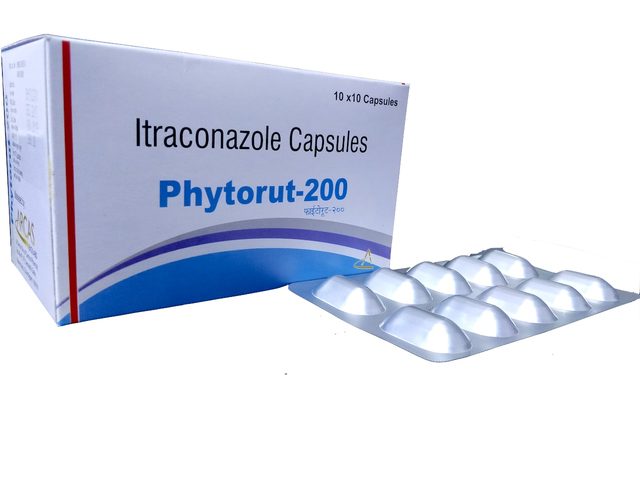
| Composition | Itraconazole IP 200 mg (as pellets) |
|---|---|
| Dosage Form | Capsule |
| Pack Type | Alu-Alu blister |
| Pack Size | 10 x 10 Capsules |
| MRP | ₹ 2477.4 |
| Therapy | Dermatology / Gynaecology – fungal infections — Triazole antifungal |
| Storage | Store below 30 °C in a dry place, protected from light and moisture. Keep out of reach of children. |
📱 WhatsApp Enquiry📞 Call: +919041677932
About PHYTORUT-200 Capsule
PHYTORUT-200 is itraconazole 200 mg in a pellet-filled capsule, packed 10 x 10 in Alu-Alu blisters. It is the high-strength member of Trumac Healthcare’s PHYTORUT range (100 mg capsules, 50/65/130 mg super-bioavailable capsules, 1% dusting powder and soap), made at WHO-GMP certified partner units for the derma and gynaecology PCD franchise and wholesale range.
Itraconazole is the drug of choice for the chronic, recurrent tinea (dermatophytosis) that has become the commonest skin complaint in Indian clinics, and the 200 mg once-daily dose is what dermatologists now prescribe for resistant tinea corporis and cruris, onychomycosis pulses and vulvovaginal candidiasis. A single 200 mg capsule replaces two 100 mg capsules, improving compliance over the 2–6-week courses the disease needs.
For derma and gynae PCD partners, itraconazole is the largest-volume systemic antifungal in India, with repeat demand every monsoon and in every family where tinea spreads. PHYTORUT-200 completes the ladder with PHYTORUT-100 and the super-bioavailable strengths, alongside Trumac’s luliconazole, terbinafine, ketoconazole and antifungal-steroid topical products.
Trumac offers PHYTORUT-200 on a monopoly PCD pharma franchise for your district, as wholesale stock for derma distributors, and with visual aids and product cards. Ask for the derma product list and net rates on WhatsApp.
Indications
- Dermatophytosis – extensive, chronic or recurrent tinea corporis, cruris, pedis and manuum, including cases unresponsive to topical therapy
- Onychomycosis (fungal nail infection) of fingernails and toenails, as pulse therapy
- Vulvovaginal candidiasis, oral and oesophageal candidiasis
- Pityriasis versicolor and seborrhoeic dermatitis unresponsive to topical treatment
- Systemic mycoses on specialist advice – aspergillosis, histoplasmosis, blastomycosis, sporotrichosis, chromoblastomycosis, and maintenance in cryptococcal meningitis in HIV
- Prophylaxis of fungal infection in neutropenic and transplant patients, on specialist advice
Mechanism of Action
Itraconazole is a lipophilic triazole that inhibits the fungal cytochrome P450 enzyme lanosterol 14-alpha-demethylase, blocking the conversion of lanosterol to ergosterol, the essential sterol of the fungal cell membrane. Ergosterol depletion and the accumulation of toxic methylated sterols disrupt membrane structure and the enzymes bound to it, so the fungus stops growing (fungistatic against yeasts, and effectively fungicidal against dermatophytes at the concentrations reached in skin and nails). Itraconazole is 100 to 1,000 times more selective for the fungal enzyme than for human P450 enzymes. It is highly protein-bound and keratinophilic: it is delivered into the stratum corneum by sebum and sweat and persists in skin for 2–4 weeks after a course ends, and in nail keratin for 6–9 months, which is the basis of pulse therapy for onychomycosis. Absorption of the capsule depends on gastric acid and food – it must be taken with a full meal, and antacids or proton-pump inhibitors reduce it – and the drug is metabolised in the liver by CYP3A4 to hydroxy-itraconazole, which is itself active; both inhibit CYP3A4 strongly, the source of its many interactions. Half-life at steady state is 30–40 hours.
Dosage & Administration
Swallow the capsule whole immediately after a full meal, with water or a cola drink (acid aids absorption); do not take with antacids or within 2 hours of a proton-pump inhibitor. As directed by the dermatologist or physician: extensive or recurrent tinea corporis and cruris – 200 mg once daily for 2–4 weeks (current Indian expert consensus favours 200 mg daily for 4 weeks or longer in chronic recalcitrant cases, with topical therapy); tinea pedis and manuum – 200 mg twice daily for 7 days or 100 mg daily for 4 weeks; onychomycosis – pulse therapy of 200 mg twice daily for 7 days, repeated after a 3-week gap (2 pulses for fingernails, 3 for toenails), or 200 mg once daily continuously for 3 months; vulvovaginal candidiasis – 200 mg twice daily for 1 day or 200 mg once daily for 3 days; oral or oesophageal candidiasis – 100–200 mg daily for 1–2 weeks; pityriasis versicolor – 200 mg once daily for 7 days; systemic mycoses – 200 mg once to three times daily on specialist advice, with blood-level monitoring in serious infection. Liver enzymes should be checked before courses longer than one month and in patients with pre-existing liver disease, and at any sign of hepatotoxicity. Not for use in children unless the benefit outweighs the risk, and then by a specialist.
Side Effects
Common: nausea, abdominal pain, dyspepsia, diarrhoea, flatulence, headache, dizziness, rash and itching, and raised liver enzymes. Uncommon: vomiting, constipation, taste disturbance, menstrual disorders, oedema, urticaria, hair loss, photosensitivity, and leucopenia. Rare but serious: hepatotoxicity ranging from reversible transaminase rises to cholestatic hepatitis and, very rarely, fatal liver failure (mostly in patients with prior liver disease or other hepatotoxic drugs, but also reported in the first month of treatment in previously healthy patients); congestive heart failure and pulmonary oedema (itraconazole has a negative inotropic effect); peripheral neuropathy; hearing loss (usually transient); serious skin reactions including Stevens–Johnson syndrome, toxic epidermal necrolysis, DRESS and erythema multiforme; anaphylaxis and angioedema; hypokalaemia, adrenal insufficiency, visual disturbance, pancreatitis and raised creatine kinase. Report at once: loss of appetite, nausea, vomiting, fatigue, dark urine, pale stools or yellow skin (liver), breathlessness, swelling of the legs or sudden weight gain (heart failure), hearing loss, numbness or tingling, or a spreading rash.
Contraindications & Precautions
Contraindicated in known hypersensitivity to itraconazole or other azoles; in patients with evidence of ventricular dysfunction such as congestive heart failure or a history of it, except for life-threatening infections; in pregnancy (except life-threatening systemic mycoses) and in women of child-bearing potential not using effective contraception until the next menstrual period after stopping; and with CYP3A4-metabolised drugs that can cause QT prolongation, ergotism or other serious toxicity when their levels rise – including astemizole, terfenadine, cisapride, pimozide, quinidine, dofetilide, dronedarone, ranolazine, bepridil, halofantrine, levacetylmethadol, methadone, disopyramide, ergot alkaloids (ergotamine, dihydroergotamine, methylergometrine), eplerenone, irinotecan, lurasidone, midazolam and triazolam (oral), sertindole, ivabradine, felodipine, lercanidipine, nisoldipine, lomitapide, lovastatin, simvastatin, ticagrelor, colchicine (in renal or hepatic impairment), fesoterodine and solifenacin (in renal or hepatic impairment), and others listed in the current prescribing information. Precautions: hepatotoxicity – avoid in active liver disease, monitor liver function in prolonged courses, in patients with raised enzymes or prior drug hepatotoxicity, and stop if symptoms of hepatitis appear; cardiac – assess for heart failure risk (ischaemic or valvular disease, COPD, renal failure, oedema) and stop if signs develop; calcium-channel blockers add to the negative inotropic effect; reduced gastric acidity (achlorhydria, antacids, H2 blockers, PPIs) lowers absorption – take with an acidic drink; renal impairment and cystic fibrosis reduce exposure; hearing loss; neuropathy; cross-hypersensitivity with other azoles; use in children and the elderly only when the benefit outweighs the risk. Breast-feeding: small amounts pass into milk – avoid. Important interactions that need dose adjustment or monitoring: CYP3A4 inducers (rifampicin, rifabutin, phenytoin, carbamazepine, phenobarbital, isoniazid, efavirenz, nevirapine, St John's wort) make itraconazole ineffective – avoid; CYP3A4 inhibitors (clarithromycin, erythromycin, ritonavir, ketoconazole) raise its levels; itraconazole raises the levels of warfarin, digoxin, ciclosporin, tacrolimus, sirolimus, atorvastatin, calcium-channel blockers, oral hypoglycaemics (hypoglycaemia), corticosteroids (budesonide, dexamethasone, methylprednisolone, fluticasone – Cushing's), alprazolam, buspirone, carbamazepine, rivaroxaban, apixaban, dabigatran, vinca alkaloids, busulfan, docetaxel, trimetrexate, repaglinide, saxagliptin, salmeterol, sildenafil, tadalafil, tamsulosin, fentanyl, oxycodone, haloperidol, risperidone, aripiprazole, quetiapine, loperamide and many others. Check every co-prescribed drug before starting.
Storage
Store below 30 °C in a dry place, protected from light and moisture. Keep out of reach of children.
PHYTORUT-200 Capsule is available for monopoly-based PCD pharma franchise across India and for third-party manufacturing under your brand. WHO-GMP certified, with full visual-aid and promotional support. Become a Trumac franchise partner →
Frequently Asked Questions
Who manufactures itraconazole 200 mg capsules in India for PCD franchise?
PHYTORUT-200 is made for Trumac Healthcare at WHO-GMP certified partner units and offered on a PCD pharma franchise with monopoly rights for your district. No franchise fee or deposit; first order from ₹25,000.
What is the pack and MRP of PHYTORUT-200?
10 x 10 capsules in Alu-Alu blisters, MRP ₹2,477.40. The range also has PHYTORUT-100, the super-bioavailable 50, 65 and 130 mg capsules, and itraconazole 1% dusting powder and soap. Net rates for franchise partners and wholesalers are shared on WhatsApp.
Is itraconazole available for PCD franchise on monopoly basis?
Yes. Trumac appoints one partner per district or defined territory for its derma and gynaecology divisions, which include the whole PHYTORUT range, luliconazole, terbinafine, ketoconazole, antifungal creams and the gynae antifungal products.
Can PHYTORUT-200 be supplied on wholesale or distributor basis?
Yes. Derma distributors and stockists can buy at net rates without a franchise agreement; dispatch within 48 hours of payment from Panchkula.
How do I start a derma PCD franchise with Trumac?
Send your district, drug licence number and GST on WhatsApp +91 90416 77932. We confirm availability, share the derma product list and net rates, and dispatch the first order with visual aids.
What is PHYTORUT-200 used for?
Extensive, chronic or recurrent ringworm (tinea), fungal nail infections, vaginal and oral thrush, pityriasis versicolor, and – under specialist care – deep fungal infections such as aspergillosis and histoplasmosis.
How is itraconazole 200 mg taken?
One capsule once a day (sometimes twice a day for short courses or nail pulses) immediately after a full meal, swallowed whole, for the number of weeks the doctor prescribes; antacids and acid-suppressing tablets reduce its absorption and should be kept 2 hours apart.
Why do doctors now prescribe 200 mg rather than 100 mg for tinea?
Chronic recalcitrant tinea has become common in India, and expert consensus favours itraconazole 200 mg daily for 4 weeks or more, with topical treatment, to clear it and reduce relapse.
What is pulse therapy for fungal nails?
200 mg twice a day for one week, then three weeks off, repeated two to three times; itraconazole stays in the nail for months, so the nail keeps clearing after the pulses stop.
What are the important safety checks with itraconazole?
A liver test before long courses and at any sign of jaundice, a check for heart failure risk before starting, and a review of every other medicine the patient takes, because itraconazole raises the levels of many drugs including statins, blood thinners and some sedatives.
Can PHYTORUT-200 be used in pregnancy?
No. Itraconazole is contraindicated in pregnancy except for life-threatening infections, and women of child-bearing age should use contraception during the course and until the next period after it.
Which other antifungal products does Trumac offer for franchise?
PHYTORUT-100, PHYTORUT-50/65/130 SB, itraconazole dusting powder and soap, terbinafine tablets and cream, luliconazole cream and lotion, ketoconazole, clotrimazole, fluconazole, and the antifungal-steroid combinations, all available to franchise partners alongside PHYTORUT-200.
Same composition, second brand: PHYTOCAN-200 Capsule – itraconazole 200 mg. Both brands are supplied to PCD franchise partners and wholesalers; ask on WhatsApp +91 90416 77932 which one is free for your district.
Part of the Trumac Healthcare Antifungal, antiviral and deworming medicines list (45 products) – every systemic antifungal, antiviral, antimalarial and deworming composition with pack and MRP, all available on monopoly PCD franchise and wholesale supply.